Whale Song
The dramaturgy of cetacean-human communication through theatre.
"Humans and whales are evolutionarily distant, but united in having culture."

Megaptera novaeangliae - Marine Mammal Centre
About Me
I am a writer of plays, films, and musicals, as well as a dramaturg and accessibility advocate, originally from Australia, now based in London. My work for film has screened at international film festivals and her short horror, RED FUR was awarded Bronze at the Horror Movie Awards in Los Angeles.
For theatre I contributed to New Balance (Old Fitz Theatre, Sydney) and produced the New South Wales Premiere of Benched for Darlinghurst Theatre Company, (★★★★, TimeOut) which saw an entirely disabled creative team on a Sydney main stage for the first time. In my most recent play, Doomsday Baby (★★★★, The Upcoming) I explored the psychological horror genre for theatre.
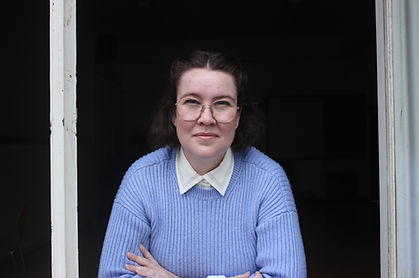
I am passionate about the genuine inclusion and intersection of queer D/deaf, disabled and neurodivergent stories in theatres and on screens. In 2021 I was shortlisted for the Arts Access Australia’s National Leadership Award, which recognises emerging disabled and neurodivergent artistic leaders.


Research Inspiration
PROJECT CETI
CETI is a nonprofit interdisciplinary organisation applying advanced machine learning and state-of-the-art robotics to listen to and translate the communication of sperm whales. Their research focus is in Dominica in the Eastern Caribbean, with partners in the US and the UK.
TOM MUSTILL
Tom Mustill is a biologist turned filmmaker and writer, specialising in stories where people and nature meet. His science book "How to Speak Whale" was the catalyst for this project.
His book explores the scientific breakthroughs being made towards decoding animal communication. With climate change threatening ever more species with extinction, would doing so alter our approach to the natural world?

Tom Mustill by Sam Mansfield
DR ELLEN GARLAND
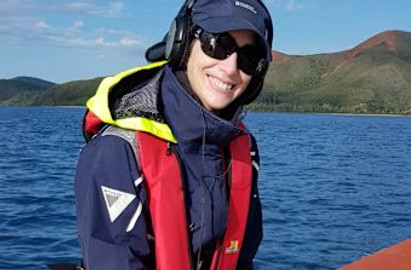
Ellen Garland is a researcher specialising in humpback whale song, based at the University of St Andrews.
In 2025 new research, led by Dr Garland uncovered that Humpback Whales used the same statistical structure in language as humans. Until now there was little evidence that these structures where similar to human language - socially learned and culturally transmitted.
Dr. Ellen C. Garland couresy of National Geographic
PROFESSOR SIMON KIRBY
Professor of Language Evolution at the University of Edinburgh and elected Fellow of the British Academy, founded the the Centre for Language Evolution.
His research and art concerns the origin and evolution of language, and the unique ways that culture and biology interact in our species.

Professor Simon Kirby by Andy Catlin.
FURTHER RESEARCH AVENUES:
-
University of St Andrews - Marine Biology department/School of Biology
-
Sea Mammal Research Unit
-
Scottish Oceans Institute
-
-
World Cetacean Alliance
-
National Oceanography Centre UK
-
Marine Biological Association UK
-
University of Southampton - Institute of Marine Biology and Ecology
-
University of Edinburgh - Centre for Language Evolution
Imagery

PROLOGUE:
Bioluminescent phytoplankton glows softly in the ocean, growing in brightness and size. A mass of sea stars containing secrets from the dark deep.
The overwhelming and awe inspiring moan of the ocean. The clicks, drones and notes of whale song cause the bioluminescent phytoplankton to react to its melody.
The call of a lone Whale cries out across time and space. It grows and swells. Calling out to long forgotten Whales from the past. The cry fades into the swell. It’s heartbreaking, haunting and unspeakably beautiful.
"whale song" Draft 1 - Jacqueline Tooley
Whale Songs Decoded extract, National Geographic,
May 2021

Visualisation of Humpback Whale vocalisation by Mike Deal

Sharma, P., Gero, S., Payne, R. et al. Contextual and combinatorial structure in sperm whale vocalisations. (2024)
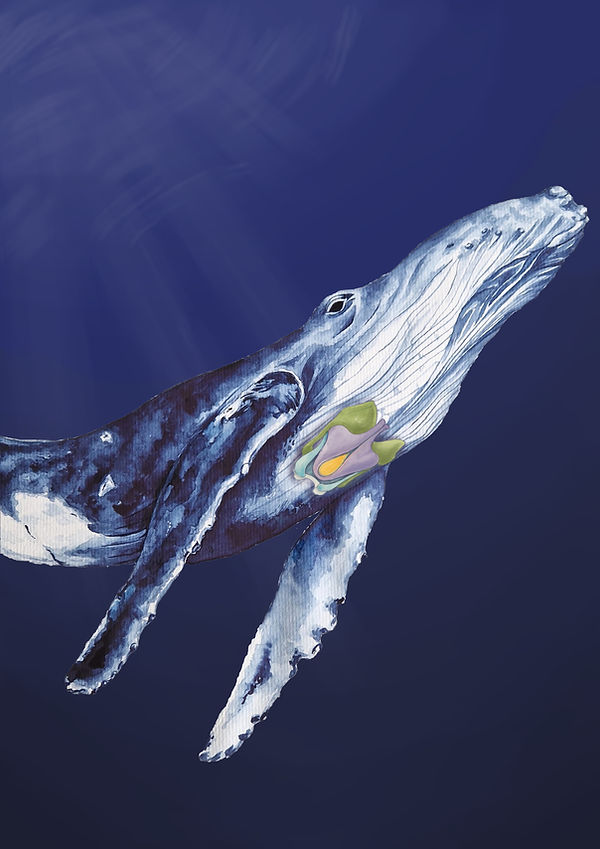
An illustration of a humpback whale shows its pink, u-shaped larynx.
Painting by Patricia Jaqueline Matic

An interdisciplinary approach to sperm whale communication. Diagram by Alex Boersma 2021.


Non-linear dramatic structures
Credit Whale Research Solutions, National Geographic

Spiral Dramaturgy model by Ulla Ryum
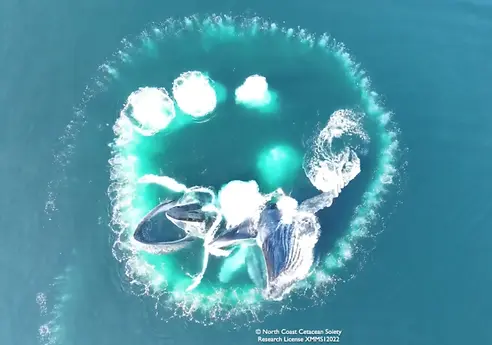
North Coast Cetacean Society